
Home / Pavement Photo Notes
Pavement Photo Notes
Look at your road photo, tick what you see, and get consistent draft wording for your inspection notes. Free, no sign-up. Your photo never leaves your browser.
Draft — for review by an engineer
What’s visible in this photo
Tick what you see and press Write draft notes. Your draft appears here.
What this tool can and can’t do
Can
- Show your photo next to the checklist, on your own device only
- Turn what you tick into the same wording every time, so notes from different people line up
- Record where the distress sits in the frame and on the road, and roughly how far it spreads
- Give you text to copy into your inspection notes and edit
Can’t
- Look at the photo for you: the draft comes from your checklist, not the image
- Measure crack width, rut depth or pothole depth
- See below the surface or find the cause
- Rate pavement condition or replace a field inspection
Common pavement distress, in plain words
- Longitudinal cracking
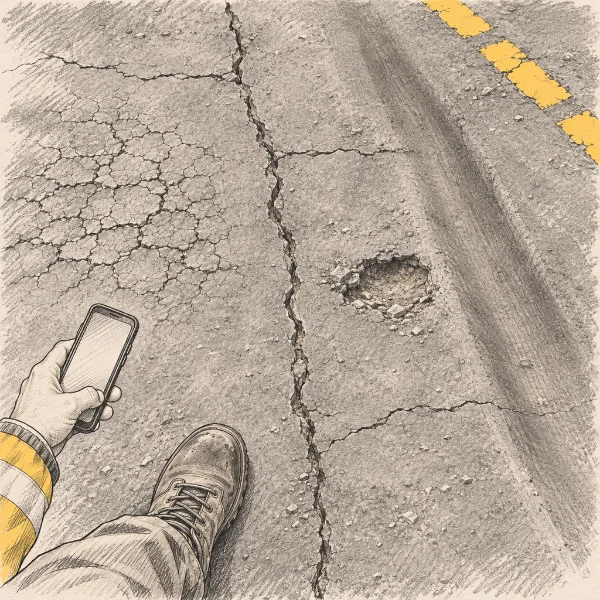
- Cracks running along the road, parallel to traffic. Often found at lane joints, along the pavement edge or in the wheel paths.
- Transverse cracking
- Cracks running across the road, roughly at right angles to the centre line, often at fairly regular spacing.
- Alligator (fatigue) cracking
- Interconnected cracks that form many-sided pieces, like chicken wire or alligator skin. Usually in the wheel paths.
- Rutting
- A sunken channel in the wheel paths, often easiest to see after rain when water sits in it.
- Potholes
- Bowl-shaped holes where surface material has broken away, sometimes down into the base.
Your agency may use its own distress manual and terms. Use those terms when you edit the draft.
FAQ
Can I use this as an inspection report?
No. It’s a draft description for a qualified engineer to review.
Is my photo uploaded?
No. The photo is shown only as a preview in your browser and is never sent anywhere. Your checklist answers are kept in this browser’s local storage so they’re there next time; the photo is not.
Does it measure crack width or rut depth?
No. A photo can’t give reliable measurements. Measure in the field.
More tools
Want the full PROJiTECH app?
Join early access. It’s free while we build.